
―
What Is the AI-Driven Transition?
―
Which Wave Is Your Job Riding Right Now?

When you wake up in the morning and open your news feed, chances are you will see at least one article saying, “AI is taking our jobs.”
But when someone asks, “So how exactly will my future change?” it becomes difficult to answer.
Most of us are left with only a vague sense of anxiety.
This article begins with that very question.
How much is AI actually changing the way we work?
And who is more likely to benefit from this change and who is more likely to be left behind?
At the 2024 Davos Forum, Kristalina Georgieva, Managing Director of the International Monetary Fund (IMF), described AI this way:
“This is like a tsunami hitting the labour market.”
— Kristalina Georgieva, IMF Managing Director, Davos 2024
A tsunami is not just a large wave.
It has the power to reshape the landscape of an entire city.
AI is similar.
This is not simply about the release of one new app.
AI is changing the entire way we work, learn, and get hired.
And what matters most is this:
Some people will encounter this change as an opportunity, while others will experience it as even greater insecurity.
―
Why It Is a “Transition,” Not a “Revolution”
―
These days, international organizations more often use the term “AI transition” rather than “AI revolution.”
The reason is simple.
AI is not merely the arrival of one new technology.
It is changing the entire social system.
Let’s take the automobile as an example.
A revolution refers to the invention of the automobile itself.
A transition, on the other hand, refers to everything that happened afterward: the road networks across entire cities, traffic light systems, driver’s license systems, and even changes in where people chose to build their homes.
In other words, it was not simply that one machine appeared.
The entire social system was redesigned.
AI is the same.
This is not simply about the arrival of ChatGPT.
The way students do homework, the way companies write reports, the way people are hired, and the way we search for information...
all of these are changing.
―
How Much Work Is Actually Changing?
―
International Monetary Fund (IMF): 40% of Jobs Worldwide Are Exposed to AI
In its 2024 analytical report, Gen-AI: Artificial Intelligence and the Future of Work, the International Monetary Fund (IMF) estimates that around 40% of global employment is exposed to AI. In high-income advanced economies, that figure rises to as much as 60%.
Among the jobs affected, roughly half may benefit from productivity gains thanks to AI. But the other half may face reduced demand or even job losses, as AI takes over core tasks.
World Economic Forum (WEF): More Jobs Will Be Created Than Lost — But…
The World Economic Forum (WEF) offers a slightly more interesting outlook in its Future of Jobs Report 2025
By 2030, it expects 170 million new jobs to be created and 92 million jobs to be displaced, resulting in a net increase of 78 million jobs.
At first glance, the numbers look hopeful.
But there is an important condition.
39% of employers expect the core skills required for jobs to change by 2030.
In other words, even if the total number of jobs can be maintained, the skills needed to do those jobs may change completely.
International Labour Organization (ILO): Six Times More Jobs Will Change Than Disappear
The organization that has answered the question of how many jobs AI will “eliminate” most carefully is the International Labour Organization (ILO).
In its 2023 report, Generative AI and Jobs, the ILO divides the impact of AI into two categories.
· Automation
: When AI fully replaces humans and the job itself disappears.
· Augmentation
: When AI becomes a human assistant, helping people complete far more work in the same amount of time.
The results were somewhat surprising.
The risk of jobs disappearing entirely because of AI was about 2.3%.
By contrast, the share of work that would need to be redesigned so that people can work with AI reached 13.4%.
In other words, there are six times more people who need to relearn how to work than people whose jobs may disappear.
| Area | Share | Meaning |
|---|---|---|
| Automation | 2.3% | Areas where jobs themselves may disappear |
| Augmentation | 13.4% | Areas where the way work is done may change completely |
AI is less like a thief stealing jobs, and more like a designer reshaping the way we work.
But is this redesign happening fairly for everyone?
―
Recent Layoffs at Big Tech Companies
―

While reports from international organizations are forecasting the future, change is already unfolding much faster on the ground inside companies.
First, the very criteria used to evaluate corporate value are changing.
In the past, revenue and growth potential were the key indicators that determined a company’s value. Recently, however, a new concept has emerged: AI Valuation.
We are entering an era in which corporate value is increasingly shaped by how much a company can reduce costs through AI, how far it can maximize efficiency, and how successfully it can restructure its organization around AI.
Private equity funds with enormous financial power are using this standard to put strong pressure on the companies they invest in, urging them to cut labor costs and introduce automation.
Second, the productivity per employee at AI companies is surpassing conventional expectations.
Salesforce, one of the leading companies in the software industry, generates about $500,000 in annual revenue per employee. By contrast, Anthropic, a company designed around AI, generates as much as $7.6 million in revenue per employee.
That is a difference of more than 15 times within the same industry.
As AI companies prove that they can generate massive revenue with relatively small teams, existing companies are coming under intense pressure to reduce their workforce and automate operations.
Third, layoffs at global big tech companies are becoming a reality.
Block, the payments and financial technology platform formerly known as Square, recently carried out an aggressive slimming-down by laying off 40% of its workforce.
Meta is also conducting a company-wide organizational review, with a recent goal of reducing its total workforce by an additional 20%.
What is especially notable is that Meta is already a highly efficient company, with revenue per employee exceeding $2.5 million. And yet, in order not to fall behind in the competition for AI transition, the company is seeking to raise that figure to around $3.24 million.
―
The Benefits of AI Are Not Distributed Equally
―
In fact, the biggest problem in the age of AI is not speed, but inequality.
Even when the same wave comes, some people are riding it with a surfboard, whileothers are standing still without even realizing the wave is approaching.
Different Realities by Occupation: A Crisis for Clerical Workers, an Opportunity for Professionals
The graph below shows the share of tasks exposed to AI by occupational group.
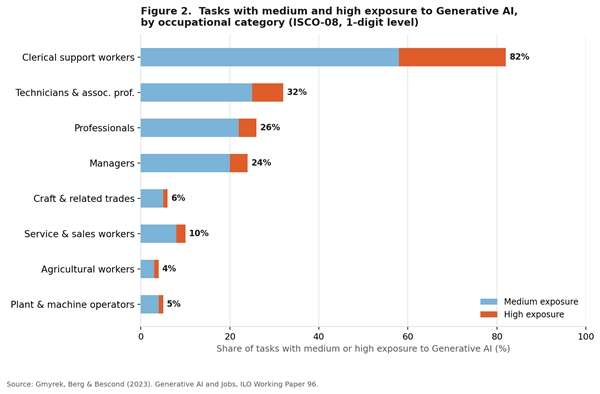
Figure 2. AI exposure by occupational group. Among clerical support workers, 82% of tasks are exposed to medium- to high-level AI impact — overwhelmingly higher than in other occupational groups. (Source: ILO WP96 (2023))
What stands out most clearly in the graph is clerical work.
Around 82% of clerical tasks are exposed to AI, and the share at high risk of automation reaches 24%.
This is why tasks such as typing, data entry, and simple report writing are already becoming areas increasingly handled by AI.
By contrast, professionals and managers may be able to use AI like a set of wings.
Areas that require complex judgment and creativity are difficult for AI to replace. Instead, these workers can use AI like an assistant and enjoy the opportunity to dramatically improve their productivity.
| Occupation | Automation Risk | Current Outlook |
|---|---|---|
| Clerical and Administrative Workers | Around 24% | At risk |
| Professionals and Managers | Low | Opportunity |
| Agricultural, Manufacturing, and Service Workers | Very low | Relatively safe |
Women and Low-Income Countries Are More Heavily Affected
The impact of AI does not appear only across occupational groups.
There is also a significant gender gap.
Women are 2.1 times more likely than men to be affected by AI automation. This is because many women are concentrated in clerical and administrative roles.
The same pattern appears in high-income countries.
Women’s exposure to automation risk stands at 6.6%, nearly twice that of men in the same group, at 3.5%.
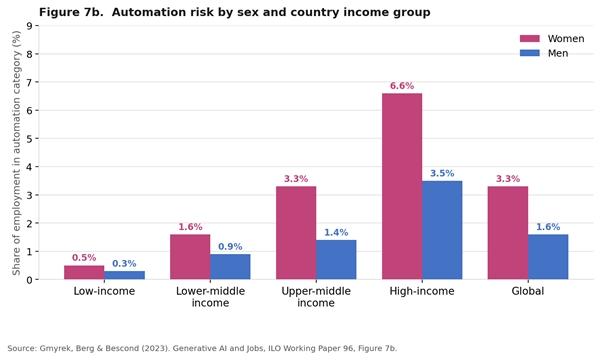
Figure 7b. Share of employment exposed to automation risk by gender and income level. Across all income groups, women are more exposed than men. Women in high-income countries face the highest level of risk, at 6.6%. (Source: ILO WP96 (2023))
The gap between countries is even more paradoxical.
| Income Level | Share Exposed to Automation Risk |
|---|---|
| High-income countries | 5.5% |
| Upper-middle-income countries | Around 3% |
| Lower-middle-income countries | Around 1.5% |
| Low-income countries | 0.4% |
At first glance, low-income countries appear to face a lower risk of automation.
They may seem safe at first.
But in reality, the opposite may be true.
Because they often lack the infrastructure needed to use AI, they are also more likely to be excluded from the opportunities for productivity growth.
UNICEF describes this problem this way:
“One child opens an AI learning platform and meets a patient tutor who explains mathematics step by step. Another child in the same country sees only a message saying the service is unavailable, restricted, or behind a paywall.”
— UNICEF Digital Impact, 2026
In the end, AI is not simply a technological issue.
It is also a question of education and opportunity.
―
AI Can Make Existing Inequalities Even Worse
―
Kate Crawford, a senior researcher at Microsoft and a leading scholar on AI inequality, warns in her book Atlas of AI (2021):
“AI is a technology of extraction from the energy and minerals, to the exploited workers, to the data it collects from us. Technical systems maintain and extend structural inequality, regardless of the intention of the designers.”
— Kate Crawford, Atlas of AI, Yale University Press, 2021
Put simply, if the world was already unequal, AI can learn from that data and reproduce the same inequalities.
That is why what matters most is not the technology itself,
but who uses it and how.
Safiya Noble, a professor at UCLA and a MacArthur Fellow, speaks in a similar vein:
“AI has the power to either bridge the gap or widen it, depending on how it is used and implemented.”
— Safiya Noble, UCLA
―
So What Should We Do?
―
Fortunately, international organizations have already proposed concrete guidelines for action.
ILO’s Proposal — Generative AI and Jobs, WP96 (2023)
The ILO emphasizes that intervention is needed not only at the level of technical training, but at the level of the system itself.
Specifically, it proposes three key measures.
· Tailored reskilling programs for women:
Women in clerical roles, who are likely to be most affected by AI, must be able to participate in training without facing practical barriers such as childcare and transportation.
· Modernizing social safety nets:
Instead of a system that only provides support after people lose their jobs, we need a flexible support structure that allows workers to maintain their income while learning new skills during the transition.
· Redesigning the education system:
From elementary school to university, curricula themselves must be redesigned to help people develop the ability to work with AI.
WEF’s Proposal — Future of Jobs Report 2025
The World Economic Forum emphasizes that governments, businesses, and educational institutions must act together.
It is also advancing the Reskilling Revolution, an initiative that aims to provide education, skills, and economic opportunities to 1 billion people by 2030.
IMF’s Proposal — Gen-AI: Artificial Intelligence and the Future of Work (2024)
The IMF warns that without technology transfer, debt relief, and infrastructure investment through development cooperation for low-income countries, the digital divide between countries could widen to an irreversible level.
UNICEF’s Proposal — Policy Guidance on AI for Children (2025)
UNICEF argues that children and young people should be included not as passive subjects of AI policy, but as active participants.
If children are not able to take part in creating AI, they may spend their entire lives merely adapting to a world shaped by AI.
―
Three Things We Can Do Right Now, From Where We Are
―
The technology gap begins to narrow when those who learn first share first.
For ourselves, it begins with learning to use AI as a tool.
You do not have to understand it perfectly.
Starting with just one repetitive task in your own work and testing whether AI can help is enough.
For the people around us, it means sharing what we know.
It means creating even one opportunity to try AI tools together with someone who has difficulty accessing them an older parent, or a neighbor who is not familiar with digital devices.
Technology gaps begin to shrink when those who know first share first.
For society, it means not stopping the questions.
“Is AI education in our school sufficient?”
“Is digital infrastructure in our community fair?”
“Are reskilling opportunities in our workplace open to everyone?”
Continuing to ask these questions as consumers, citizens, and voters is itself a force that creates change.
―
A Compass for an Age Without a Map
―
In the age of AI, the most important skill may not be coding.
It may be the ability to keep asking questions like these:
“Where is this technology taking humanity?”
“Who is writing the rules for this technology?”
“Are the benefits of technology being shared fairly with everyone?”
The future of technology is not determined by technology itself.
It is determined by the choices we make around it.

References & Sources
AI and the Labour Market
ILO. Generative AI and Jobs: A global analysis of potential effects on job quantity and quality, 2023 — Global analysis of how generative AI affects job quantity and quality(ILO)
AI and the Future Economy
IMF. Gen-AI: Artificial Intelligence and the Future of Work, 2024 — Analysis finding that nearly 40% of global employment is exposed to AI
AI and the Future of Jobs
WEF. Future of Jobs Report 2025, 2025 — Projections on job creation, displacement, and skills transformation through 2030 (WEF)
AI and Children & Youth
UNICEF. AI divide: A new fault line we cannot ignore, 2026 — How the AI divide deepens inequality for children and the case for digital inclusion (UNICEF)
AI Policy and Children's Rights
UNICEF. Policy Guidance on AI for Children, Version 3, 2025 — Child-centred policy framework for responsible AI development (UNICEF)
AI Inequality Research
Crawford, Kate. Atlas of AI: Power, Politics, and the Planetary Costs of Artificial Intelligence, Yale University Press, 2021 — Scholarly examination of how AI reproduces and amplifies existing structural inequalities (Kate Crawford)