
―
A Bathtub's Worth of Water, Hidden in One Cup of Coffee?
―
Think about the coffee you drank this morning. What's in the cup is maybe 200mL. But add up every drop of water that went into getting it there — growing the coffee plant, processing the beans, washing them, packaging and shipping — and the total comes to roughly 132 liters. That's nearly a full bathtub, hiding inside one small cup.
We're not just drinking water — we're consuming a world built out of it. The cotton shirt on your back, the meat you had for lunch, the phone you can't put down: all of it carries water you can't see. At checkout, you only pay the sticker price. The planet quietly keeps a separate tab for the water cost behind it.
A water footprint is exactly that — the invisible receipt. It doesn't just count what comes out of your faucet. It follows a product from birth to disposal and tallies every drop used along the way.
―
Q. What Is a Water Footprint?
―
A. It's the total volume of freshwater used or polluted in making everything a person, company, or country consumes.

▲ Coffee, meat, and grains — the things we consume every day — carry water you never see.
That includes water used directly, plus "virtual water" — water used on your behalf in other regions and countries.
A water footprint splits into two layers. The water you use showering or washing dishes is your direct water footprint. The water spent producing the food, clothes, and phones you buy is your indirect water footprint. For most people, the indirect footprint dwarfs the direct one.
Take the shirt you're wearing right now. Cotton gets grown, spun into thread, dyed, sewn into a shirt, shipped to a store. Every step along the way uses water. The shirt hangs dry in your closet, but behind it stretches a long trail of water through farms and factories.
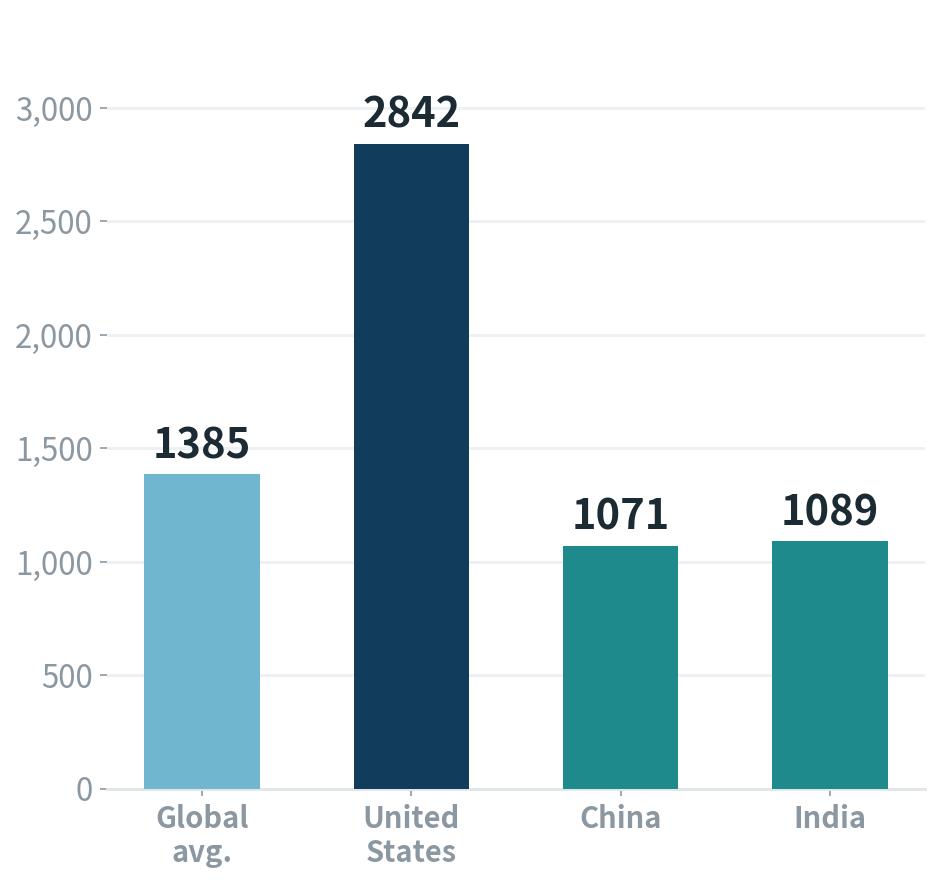 ▲ The global average water footprint is 1,385 m³ per person per year — the US figure is 2,842 m³, more than double. China (1,071 m³) and India (1,089 m³) are actually below the global average. Water footprint tracks closely with affluence. Source: Water Footprint Network / Hoekstra & Mekonnen, PNAS (standard reference study based on 1996–2005 consumption data)
Looking at the differences between countries, water footprint clearly isn't just a function of population. Wealthier societies that consume more meat, processed food, clothing, and electronics tend to draw far more water from abroad. Our shopping carts leave footprints in rivers and aquifers on the other side of the world.
The Three Colors of a Water Footprint

The green water footprint is rainwater stored in the soil and used by growing plants. It's closely tied to agriculture, horticulture, and forestry — water that falls from the sky and stays in the ground.
The blue water footprint is water drawn from rivers, lakes, reservoirs, and groundwater. Irrigated agriculture, factories, and household taps all draw on it — it's what most people picture first when they hear "using water."
The grey water footprint is the amount of water needed to dilute or treat pollution back down to safe quality standards. No grey water actually flows anywhere — it's a way of converting pollution into an equivalent volume of water.
You need all three colors together to see the real picture. The same cup of coffee can carry a very different environmental burden depending on whether it was grown where rain is plentiful, pumped from groundwater in a water-stressed region, or produced using pesticides that polluted local water supplies.
―
Q. Why Does the Water Footprint Matter?
―
Water seems to be everywhere, but it isn't handed out equally. For some, it's an everyday convenience — turn the handle and it flows. For others, it's hours of labor every single day, and sometimes a barrier that forces them to give up school or work.
The Reality in 2026
According to UN-Water and UNESCO's United Nations World Water Development Report (WWDR) 2026 — subtitled "Water for All People: Equal Rights and Opportunities" — released in March 2026, 2.1 billion people worldwide still lacked access to safely managed drinking water as of 2024.
A separate 2026 United Nations University (UNU-INWEH) report put the global economic losses from drought at roughly $307 billion a year. This isn't a forecast anymore — it's already happening.
The number that stays with you most from this report is 250 million hours a day — the combined time women and girls worldwide spend hauling water.
Two hours that could have gone to school, three hours that could have earned an income, one hour that could have simply been rest — all of it lost to walking with a water jug. In one rural community in Kenya, women had to walk up to four hours a day just to get water. For someone living this reality, a water footprint isn't a consumption habit — it's a mark left on the soles of their feet.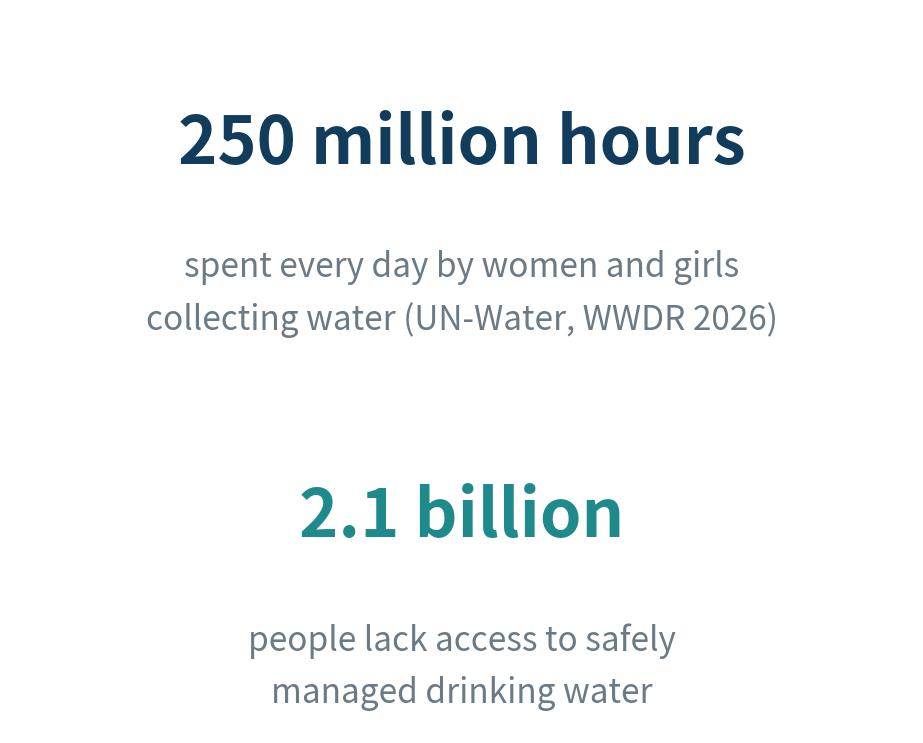 ▲ Women and girls worldwide spend 250 million hours every day collecting water, and 2.1 billion people still lack access to safely managed drinking water. Source: UN-Water/UNESCO, World Water Development Report 2026
The number that stays with you most from this report is 250 million hours a day — the combined time women and girls worldwide spend hauling water.
That figure is too big to feel real. Break it down to one person's day, though, and it comes into focus. Two hours that could have gone to school, three hours that could have earned an income, one hour that could have simply been rest — all of it lost to walking with a water jug. For someone living this reality, a water footprint isn't a consumption habit. It's a mark left on the soles of their feet.
In one rural community in Kenya, women had to walk up to four hours a day just to get water. When a well was finally built in the village, the change didn't stop at water. Women started savings groups and small businesses. Children started recovering from the illness and malnutrition caused by contaminated water. One well changed health, education, and income all at once.
―
Not a Water Crisis — "Water Bankruptcy"?
―
In January 2026, UN University researchers reached for stronger language. They declared the world has moved past a simple water crisis into an era of "water bankruptcy."
The metaphor borrows from finance. Think of the water that rain and snow renew each year as our "paycheck." Groundwater, glaciers, and wetlands are the "savings" we've built up over a long time. We're not just overspending the paycheck — we're now dipping into savings too. Pollution is like setting fire to what's left in the account.
―
Which Products Have the Biggest Water Footprint?
―
Water footprints diverge most sharply around what we eat. Livestock products tend to have large footprints because they stack up water for feed crops, drinking water for the animals, and water used in barns and processing facilities. Vegetables and grains, by comparison, tend to be relatively small.
That said, a single number doesn't mean all meat is bad and all vegetables are good. Where and how something is produced matters. Comparing pasture-raised livestock in a rain-rich region to crops irrigated with groundwater in a water-stressed area isn't a simple apples-to-apples comparison.
Tech isn't exempt either. Semiconductor plants use enormous volumes of ultrapure water to keep production lines dust-free, and data centers use water to cool overheating servers. Every photo you back up to the cloud and every AI query you run isn't entirely separate from water use. The digital world, in the end, still stands on rivers, power plants, and cooling water.

▲ The water we use directly at home matters, but the indirect footprint hidden inside food and products can be far larger.
So a water footprint works less like an absolute score stamped on a product and more like a map that starts a question. Where did this come from? Is that region short on water? Was the water polluted during production? Once you know the number, your consumption gets a little more precise. If you're curious about the footprint of a food you love, this resource is a good place to start.
―
What's Your Own Water Footprint?
―

The Water Footprint Network's calculator lets you estimate your own annual water footprint based on your country, diet, and consumption habits. It's less a precise measuring device than a compass pointing toward your lifestyle's overall direction.
You might be surprised to see the biggest line item isn't showers — it's food. That's the whole point of a water footprint: there's more water we don't see than water we do.
―
Two Ways to Cut Your Water Footprint
―
So what can we actually do? The answer doesn't stop at "use less water." Along with turning off the tap, it takes choosing differently about the water hidden in the products we buy.

Two Ways to Reduce Your Water Footprint
1. Cut your direct footprint at home
Turn off the tap while brushing your teeth, shorten your showers, and use low-flow toilets and showerheads. Don't pour medication, oil, or paint down the drain — that reduces both how much water you use and how much you pollute.
2. Cut your indirect footprint in your shopping cart
You don't have to cut out meat entirely — swapping one or two meals a week for plant-based options helps. Buy only what you'll eat to cut food waste. Keep clothes and devices longer, and look into whether the companies you buy from manage water-stressed supply chains responsibly.
―
Individual Savings Alone Aren't Enough
―
Frame the water footprint purely as a matter of individual conscience, and you miss the much bigger pipes involved. Without changes to agricultural irrigation, urban water leakage, industrial processes, corporate supply chains, and international trade, there's a hard limit to what consumers alone can accomplish.

Governments and companies need to disclose where their raw materials come from, how much they've drawn from water-stressed regions, and how much pollution they've cut. The European Union is developing a common standard through its Product Environmental Footprint (PEF) methodology, allowing comparison of environmental impact across a product's full life cycle.
―
In the End, the Water Footprint Is a Human Story
―
Follow a water footprint far enough and you meet a farmer behind a cup of coffee, a cotton field behind a t-shirt, a semiconductor plant's water behind a smartphone. And eventually, a child walking with a water jug in a home with no tap.
Water doesn't follow borders. One country's consumption can drain another country's rivers and aquifers. One region's drought can shake global food prices. Which is why sharing water fairly and managing it together isn't just environmental policy — it's a matter of human rights and peace.
You don't need to change everything starting today. Cutting your shower by two minutes, not buying food you'll throw away, keeping your clothes and phone a little longer — any of these is a fine place to begin. And every so often, before you pick something up, try asking: "Where did the water in this come from?"
That one question is enough to make invisible water visible. Making the footprint we leave a little lighter today is the first step toward handing the next generation a more peaceful path for water to flow.
Written by Sharon Choi
Director of Planning, Sunhak Peace Prize Secretariat
References
1. UN-Water / UNESCO, The United Nations World Water Development Report 2026 (March 2026)
2. United Nations University (UNU-INWEH), Global Water Bankruptcy (January 2026)
3. Hoekstra & Mekonnen, "The Water Footprint of Humanity," PNAS (2012)