
—
Q. What Is Wet-Bulb Temperature?
—
Wet-Bulb Temperature
Wet-bulb temperature is a measure that considers both air temperature and humidity. It shows how well sweat can evaporate and how effectively our bodies can cool down.
Put simply, wet-bulb temperature represents the heat our bodies actually have to endure in humid air.
Traditionally, when wet-bulb temperature reaches 35°C, it is understood that the human body’s ability to regulate its temperature reaches its limit. Even for a healthy person, this is the point at which resting in the shade and drinking enough water may no longer be enough to cool the body.
—
Q. Why Is Wet-Bulb Temperature Important?
—

▲ This image shows how high temperature and humidity interfere with the body’s natural cooling function.Source: Sunhak Peace Prize
◎ Impact on Human Health
Our bodies have a highly effective cooling system: sweat.
When temperatures rise, sweat released through the skin evaporates, carrying heat away and preventing the body from overheating.
But when there is too much moisture in the air, the situation changes.
Even if sweat remains on the skin, it does not evaporate easily. As a result, even if we drink enough water and rest in the shade, it becomes difficult for the body to release heat. In severe cases, this can lead to heat exhaustion, heatstroke, or organ damage.
When wet-bulb temperature approaches 35°C, the body’s cooling function can break down within just a few hours.
Moreover, people who are especially vulnerable to heat such as older adults, children, people with chronic illnesses, and outdoor workers can face serious danger even at lower temperatures.
◎ Impact on Ecosystems and the Environment
Rising wet-bulb temperatures do not affect humans alone.
Extreme heat and humidity can alter the habitats of plants and animals, while also placing greater stress on crops and livestock.
As demand for air conditioning rises sharply, power grids and the environment can also come under greater pressure.
Who is most vulnerable to high wet-bulb temperatures?
—
Q. How Is Wet-Bulb Temperature Measured?
—
◎ How Wet-Bulb Temperature Is Measured
The principle behind the measurement is simpler than it may seem. A traditional wet-bulb thermometer uses two thermometers. One is a dry-bulb thermometer, which measures the actual air temperature. The other is a wet-bulb thermometer, whose tip is wrapped in a cloth soaked with water.
As water evaporates from the wet cloth, it draws heat away and lowers the reading. The drier the air, the faster that evaporation happens and the lower the wet-bulb reading drops. The more humid the air, the harder it is for water to evaporate, so the wet-bulb reading climbs closer to the actual air temperature. That resulting number is the wet-bulb temperature.

▲ A diagram showing how evaporation from the wet cloth draws heat away from the thermometer.Source: ClimateCheck
Want to calculate wet-bulb temperature yourself?
◎ Reading the Numbers
Knowing the wet-bulb temperature gives a much clearer picture of just how dangerous a hot day really is for the human body. In places like Delhi, India, where extreme heat and high humidity often occur together, it can matter as much as the air temperature itself.
June 29, 2022: Wet-bulb temperature 33.7°C
July 16, 2022: Wet-bulb temperature 36.2°C
Source: Hindustan Times
The traditionally cited limit of human survivability is a wet-bulb temperature of 35°C. Those readings show just how dangerous Delhi's heat had become. More than 160 people are reported to have died in the extreme heat that hit Delhi that summer.

▲ In the summer of 2022, wet-bulb temperatures in Delhi, India, approached or exceeded the 35°C threshold considered the limit of human survivability.Source: Getty Images Plus
Unfortunately, similar crises keep recurring. In 2024, Pakistan and other parts of South Asia endured severe heat waves, and in 2025, millions of people across India and Pakistan faced prolonged, extreme heat stress.
The World Bank has warned that extreme heat could make parts of India extremely difficult places to live. Combined with water scarcity and soil degradation, it could also deal a heavy blow to agriculture and livestock farming.
Curious how global warming is reshaping ecosystems?
―
Q. How Are Climate Change and Wet-Bulb Temperature Connected?
―
◎ A Warmer World Makes for Hotter, Wetter Air
As the planet's average temperature rises, the air can hold more moisture. As days with both high heat and high humidity become more common, wet-bulb temperatures naturally rise along with them.
In 2020, a research team at Columbia University analyzed global weather data from 1979 to 2017. They found that dangerously high wet-bulb temperatures were already being recorded in places including India's eastern coast and northwest, Pakistan, the Red Sea coast, the Gulf of California, and the southern Gulf of Mexico.

▲ A map showing regions worldwide that have recorded a daily wet-bulb temperature of at least 31°C. Deeper yellow and red indicate higher recorded values.Source: Science Advances
◎ Future Climate Scenarios
In 2021, the UK's national weather and climate service, the Met Office, analyzed how heat stress risk would change as global average temperatures rise.
The analysis found that at 2°C of warming above pre-industrial levels, the number of people exposed to extreme heat stress could grow from about 68 million today to roughly 1 billion. At 4°C of warming, close to half the world's population could be living in regions facing severe heat stress risk.
And this isn't a distant future problem. A 2025 joint report from the World Health Organization (WHO) and the World Meteorological Organization (WMO) found that 71% of the global workforce — about 2.4 billion people — are already exposed to excessive heat. Extreme heat threatens the lives and health of countless workers every year and is linked to tens of millions of workplace injuries.
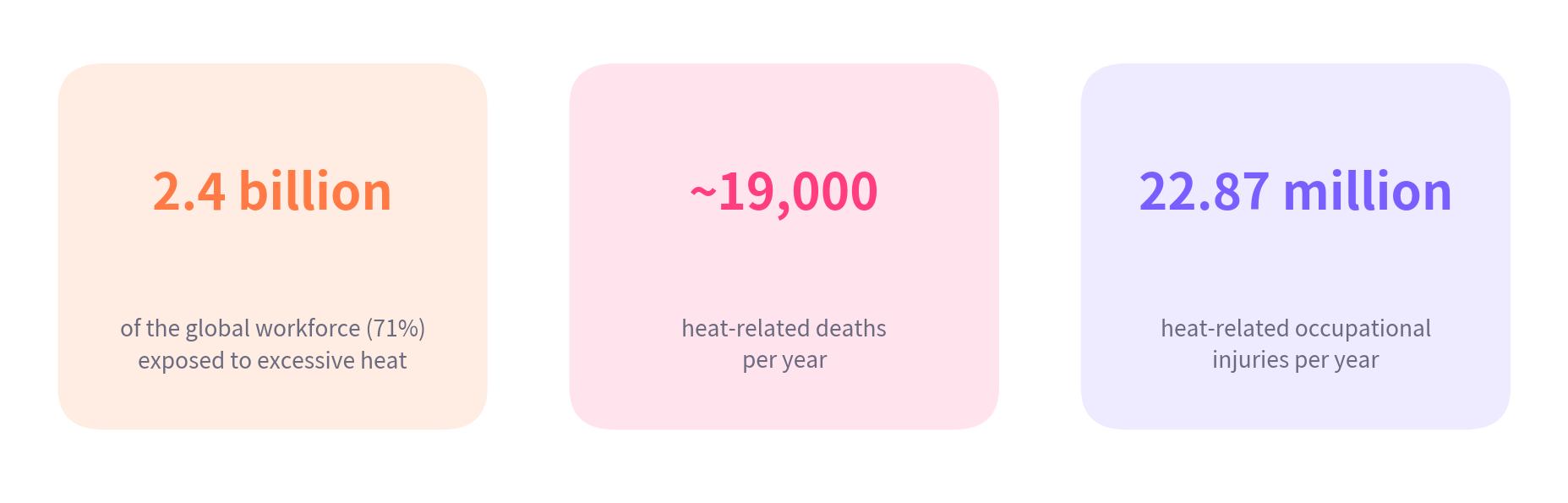
▲ 71% of the global workforce — roughly 2.4 billion people — are exposed to excessive heat.Source: WHO/WMO, Climate Change and Workplace Heat Stress, 2025
◎ Europe Is No Longer Safe, Either
Extreme heat isn't just a South Asian problem anymore. Europe, once considered to have a relatively mild climate, has been hit by repeated record-breaking heat waves. Temperatures above 45°C have been recorded in southern Europe, and multiple countries have set new all-time highs.
There are structural reasons Europe is especially vulnerable. Many homes were built to retain heat through cold winters, and air conditioning remains uncommon in parts of the continent. That leaves older adults, low-income residents, and people living alone at greater risk during prolonged heat waves.
The WHO considers Europe the fastest-warming region in the world. Recent studies on heat-related mortality confirm that climate change is making dangerous heat both more frequent and more intense.
The Met Office warns that even at wet-bulb temperatures of 32°C and above, vulnerable groups and outdoor workers can face serious danger. As warming continues, these conditions are likely to recur across more continents and more cities.

▲ A map showing regions that could experience more than 10 days a year with wet-bulb temperatures above 32°C if global average temperatures rise 4°C above pre-industrial levels.Source: Met Office
Climate scientist Matthew Huber has warned that by the end of this century, extreme conditions approaching a wet-bulb temperature of 35°C could become far more common than they are today. A number once treated as a theoretical ceiling is edging closer to everyday reality.
―
We Need to Act
―

▲ Protecting those most vulnerable to extreme heat today, and slowing global warming for the long term, both need to happen together.Source: Sunhak Peace Prize
Rising wet-bulb temperatures show just how directly climate change can affect the human body. If temperature and humidity continue to rise as they are now, more regions may become difficult places to work, live, and produce food.
Countries and cities must prepare heatwave warning systems, cooling shelters, safe labor standards, medical response systems, and climate-resilient buildings. At the same time, we must reduce greenhouse gas emissions to prevent an even more dangerous future.
In other words, we need to protect lives today while also lowering tomorrow’s temperatures.
“Can recycling and saving a little electricity really make a difference?”
That is a fair question.
Individual action alone cannot stop the climate crisis.
But it can help protect someone from extreme heat, strengthen community preparedness, and become part of the force that drives larger policy change.
Five Things We Can Do
1. Check on neighbors during heatwaves
When a heatwave warning is issued, check in on older adults living alone and neighbors around you.
2. Support the safety of outdoor workers
Remember that outdoor workers need water, shade, sufficient rest breaks, and clear heat safety standards.
3. Share information about cooling shelters
Check nearby cooling facilities and local support services, and share that information with those who may need it.
4. Reduce emissions in daily life
Turn off unnecessary electricity, use public transportation, walk or cycle when possible, and choose products that can be used for a long time.
5. Support larger climate action
Support policies and community efforts that reduce greenhouse gas emissions and protect people who are vulnerable to extreme heat.
One small action can help protect the life of someone facing extreme heat today. And if we raise our voices together, we can also help create the larger changes needed to lower the temperature of the Earth that future generations will inherit.
Protecting one another now and slowing the pace at which the planet is heating up is both a responsibility to the climate and a promise of peace for future generations.
Read More
Written by Sharon Choi
Director of Planning
Sunhak Peace Prize Secretariat
References
2. WHO·WMO, Climate Change and Workplace Heat Stress: Technical Report and Guidance (2025)
3. WMO, State of the Global Climate 2025 (2026)
4. UK Met Office, "One Billion Face Heat-Stress Risk from 2°C Rise" (2021)