―
What Is a Fair Starting Line?
―
The world isn't divided only by borders or languages. Invisible factors — capital, technology, medical care, education, and climate-response capacity — are drawing an unseen boundary between North and South.
On one side sit the advanced nations of the Northern Hemisphere, equipped with all these resources. On the other, the developing countries of the Southern Hemisphere, many of which haven't even built basic economic foundations yet.
Picture a marathon. One runner stands at the starting line in the latest shoes, sports drink in hand. Another has to start a full kilometer behind the line, in worn-out sneakers. Sure, they're technically in the same race — but would you really call that a fair competition?
That's how the global system works, too — everyone starts from an unequal line, and the gap just keeps growing.

"The Global North–South Divide generally refers to the socio-economic and political split between the wealthy, industrialized countries of the Northern Hemisphere (the 'Global North') and the poorer, developing countries of the Southern Hemisphere (the 'Global South')."
— UN Conference on Trade and Development (UNCTAD)
―
Case in Point: Rich Nations' Trash
on Developing Nations' Beaches
―

That water bottle you drank from, the plastic packaging you tossed — is it really being recycled? Most of us sort our waste and trust the word "recycling," but few of us know what happens next.
Over 50% of U.S. plastic waste is exported to developing countries (Source: GAIA, 2021). When China banned waste imports in 2018, that volume simply shifted to Malaysia, Indonesia, Thailand, and beyond.

▲ The e-waste dump at Agbogbloshie, Ghana.
Agbogbloshie in Ghana is the textbook example — one of the world's largest e-waste dumps, where children take apart electronics with their bare hands to extract scrap metal.
The problem is what that exposes them to: lead, mercury, cadmium, and other toxins, all seriously endangering their health. Waste that wealthy nations label "recycling" often never gets properly processed at all — it just ends up polluting the rivers, seas, and towns of poorer countries.
This isn't just an environmental story. It's a structural inequality — someone else's life gets sacrificed to keep our part of the planet looking clean.
―
2024–2025 Global North–South Divide at a Glance
―

▲ This map shows projected per-capita GDP worldwide for 2025. Darker blue means higher income; darker orange or red means lower income.Source: IMF, World Economic Outlook DataMapper
This map alone makes the Global North–South Divide impossible to miss.
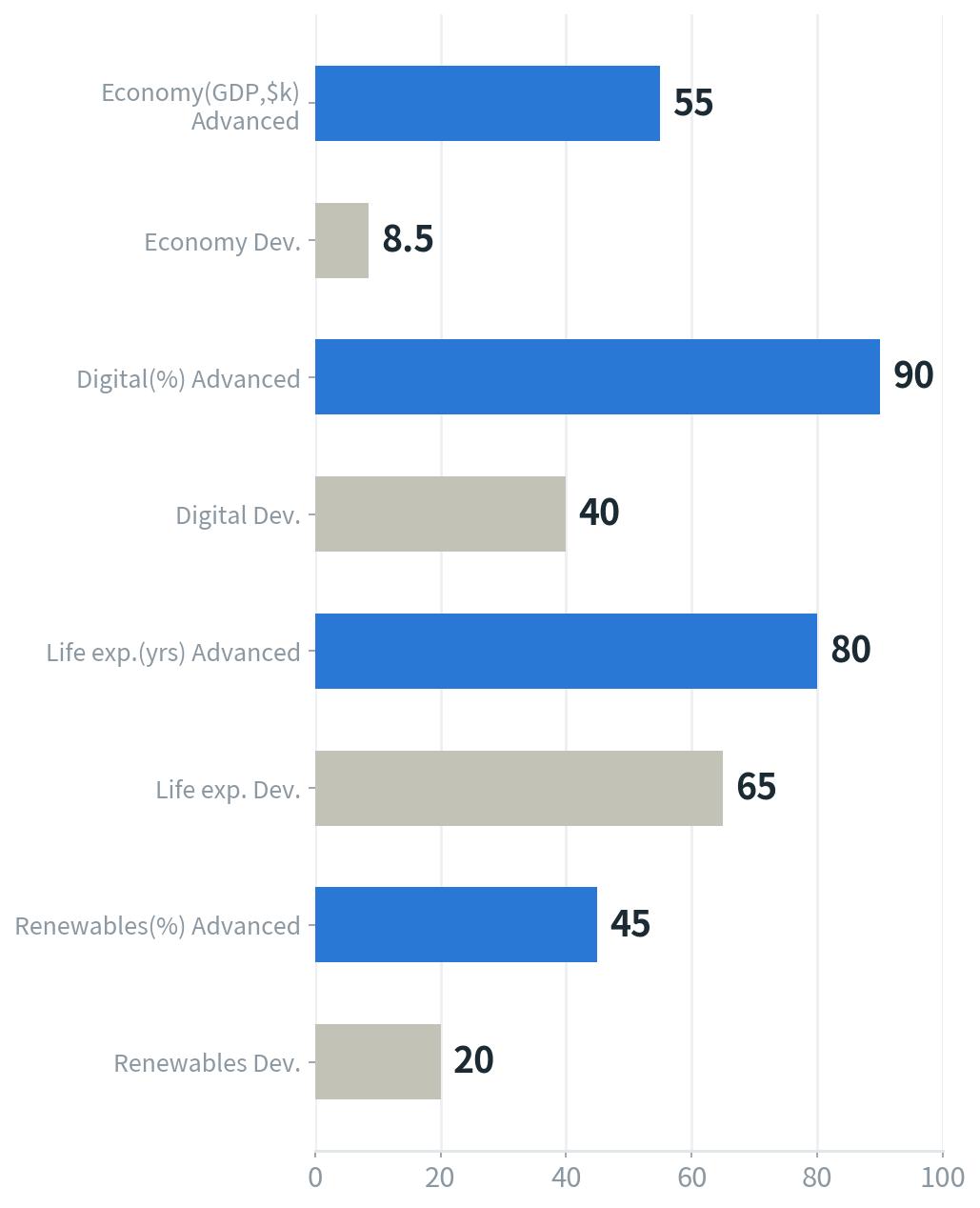
▲ Economy ($55k vs $8,500 GDP), digital (90%+ vs under 40%), health (80+ vs under 65 years), climate (45% vs under 20% renewables) — the North–South gap is stark across all four dimensions.Source: IMF, ITU, WHO, UNEP (2024)
● Economic Gap
According to the IMF, in 2024 advanced economies averaged about $55,000 in per-capita GDP, while developing economies averaged just $8,500. Put differently: one person's income in the North supports what six people have to live on in the South. This isn't just a number — it shapes opportunity, livelihood, and how stable a life can even be.
Many African nations carry a debt-to-GDP ratio above 60%, paying enormous interest every year just to stay afloat — not to grow.(Source: IMF World Economic Outlook, 2024)
• 2024 advanced-economy average per-capita GDP: $55,000
• Developing-economy average: $8,500
• African debt-to-GDP ratio: over 60%
● Digital Divide
You're able to read this article because you have digital access. Global internet penetration sits at 74% as of 2025 (2.2 billion people are still offline). High-income economies reach 94% — nearly everyone — while low-income economies remain at just 23%. In other words, three out of every four people in low-income countries have never been online.

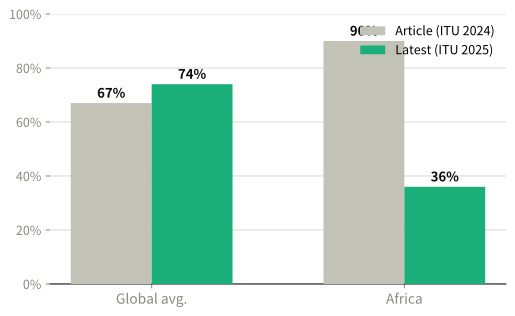
▲ Global internet penetration was revised upward from 67% (2024 data) to 74% (2025 latest) — though Africa remains at just 36%.Source: ITU, Facts and Figures 2025
This gap goes well beyond connectivity — it becomes a barrier to digital finance, online education, and e-commerce, all entry points to tomorrow's economy.(Source: ITU, Facts and Figures 2025)
• Global internet penetration: 74% (2025)
• High-income economies: 94% / Low-income economies: 23%
• Growth in digital finance & e-commerce: 15% (North) vs. 5% (South)
● Health and Medical Gap
Get the same illness in two different countries, and your odds of treatment can be worlds apart. Advanced economies average a life expectancy over 80 years; many developing countries stay under 65. That's a 15-year gap in how long you get to live, decided entirely by where you happened to be born.
The WHO has set a goal of expanding healthcare access across Africa by 30% by 2025 — but funding and policy support remain far behind schedule.(Source: WHO World Health Statistics 2024)
• Advanced economies: average life expectancy over 80 years
• Developing economies: many under 65 years
• Healthcare infrastructure shortfalls make 2025 access targets unlikely
● Climate Gap
Climate crises hit everyone, but they hit the most vulnerable hardest. According to UNEP, climate disaster losses topped $350 billion in 2024 — 70% of it in developing countries. Split that over a year, and it's roughly $960 million a day, mostly draining out of countries that barely emit any carbon to begin with.
Advanced economies have pushed renewable energy to 45% of their mix; developing economies remain under 20%. The North carries more responsibility for emissions — but it's the South, home to most climate-vulnerable countries, that pays the heavier price.(Source: UNEP Emissions Gap Report 2024)
• Annual climate-disaster losses: over $350 billion (70% in developing countries)
• Renewable energy share: 45%+ (North) vs. under 20% (South)
―
Why Does This Divide Matter?
―
This divide isn't just a headline or a line in a report. Climate refugees, food shortages, spreading disease, border conflict — the fallout eventually comes back around to all of us.
And this isn't only a problem for today. It's the baseline that will shape the conditions the next generation is born into. If we don't act now, we may be telling this exact same story ten years from now.
―
International Efforts: Numbers and Limits
―

▲ Shows the UN's 17 Sustainable Development Goals, adopted in 2015.Source: UN, Sustainable Development
In 2015, the UN published a to-do list for all of humanity: the Sustainable Development Goals (SDGs) — 17 targets covering poverty, education, climate, and more, all meant to be reached by 2030.
But heading into 2025, progress sits at just 50%. Out of 17 goals, only about 3 are actually on track. Climate action, ecosystem protection, inequality, peace and institutions — these areas are lagging badly. The $100 billion a year in climate finance that wealthy nations promised? Still less than half delivered.(Source: SDG Progress Report 2024)


▲ More than 65% of SDG targets are stalled or slipping backward. Only 17% are on track or already achieved.
• 17 SDGs set — under 50% achieved so far
• $100 billion/year pledged — still under half delivered
The World Bank and IMF haven't sat still, either — a $50 billion support package for low-income countries in 2024, aimed at digital education, smart agriculture, and infrastructure. Still, there's a long way to go.
Budgets, policies, and systems are all built around wealthy nations by default — which means help takes a long time to actually reach the countries that need it most.
―
What Can We Do?
―

So should we just wait for governments and international bodies to fix this? Thankfully, no. Bridging the Global North–South Divide isn't only a job for nations and institutions. The small choices we make every day can make a difference too — choosing fair-trade coffee, backing ethical brands, signing an environmental petition. Each one becomes a link in the chain that narrows the gap.
Seven Actions We Can Take
1. Buy fair-trade products
Ensures fair compensation for producers in developing countries.
2. Choose ethical brands
Support companies that take social responsibility seriously.
3. Donate to online tutoring and education
Help close the digital education gap.
4. Give away unused devices
Turn old tech into someone else's learning opportunity.
5. Travel locally when you can
Put money directly into developing-region economies.
6. Join environmental and human-rights campaigns
Add your voice to the push for better policy.
7. Support startups in developing countries
A sustainable way to help build economic independence.
―
True Fairness Isn't a Starting Line —
It's Built in the Process
―
The Global North–South Divide isn't simply about who has more money.
It's a question of survival — some people get vaccinated and live, others die without ever seeing basic medical care. And it's a question of dignity — some take opportunity for granted, while others never even get to stand in front of it.
Closing this gap takes more than temporary sympathy. It takes the imagination to rethink the structure and the courage to actually act on it. That's the most powerful kind of change available to us, right now.
So — what kind of world do we want? One full of walls, or one built on bridges? This is exactly the moment that calls for our imagination, and our courage.
Written by Sharon Choi
Director of Planning, Sunhak Peace Prize Secretariat
Read More
What Are the Least Developed Countries?
What Is Universal Health Coverage?
References
1. GAIA, Waste Trade Report (2021)
2. IMF, World Economic Outlook DataMapper
3. IMF, World Economic Outlook (2024)
4. ITU, Facts and Figures 2025
5. WHO, World Health Statistics 2024
6. UNEP, Emissions Gap Report 2024
7. UN, Sustainable Development