
―
What Is Gender Equity in STEM?
Is Science Really a Game for Everyone?
―
For decades, the crash test dummies used in automobile safety tests were designed based on the body of an “average male.”
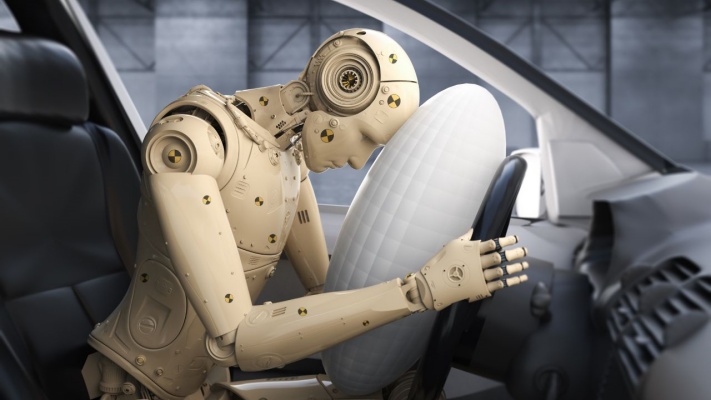
As a result, in the very same accident, women were statistically more likely to suffer severe injuries.
Was this discrimination?
Or was it simply the default setting of technology?
This question goes beyond car safety.
It asks a deeper question
: Who has science and technology been designed for?
“Science is not a game for boys.
It’s not a game for girls.
It’s a game for everyone.”
These words were spoken by Nichelle Nichols, the actress who played Lieutenant Uhura, the communications officer aboard the starship Enterprise in the 1960s television series Star Trek.

But this line did not remain just a memorable quote from television.
In the 1970s, Nichols took action alongside NASA.
Carrying the message that
“Black people and women can become astronauts too,”
she led recruitment campaigns and traveled the country to promote opportunities for women and minorities in science.
And the results were real.
America’s first female astronaut, Sally Ride, and its first Black astronaut, Guion Bluford, would go on to make history.
NASA later honored Nichols with these words:
“She broadened the boundaries of both Earth and space.”
So where do we stand today?
In laboratories, data centers, and startup offices, there are certainly more diverse faces than before.
Yet one question remains:
Has science truly become a game for everyone?
It is here that the question of Gender Equality in STEM begins.
―
What Is Gender Equity in STEM?
“It’s not simply about increasing the number of women.”
―
Gender equality in STEM (Science, Technology, Engineering, and Mathematics) is not just a simple wish that
“There should be more girls in science.”
UN Women defines gender equality in STEM as:
“Building systems that ensure women have equal access to, participation in, and leadership within STEM fields.”
Put more simply, it raises questions like these
• Are the doors truly open for women to enter?
• Once inside, is the environment one they can sustain and thrive in?
• Is there a seat for them at the decision-making table?
These questions are not only for scientists.
Not only for developers.
They apply to all of us who already live with and rely on technology every day.

―
The STEM Gender Gap
From the Moment of Entry to the Moment of Exit
―
“But hasn’t it improved compared to the past?”
To answer that question, let’s follow the numbers.
First, let’s look at the big picture.
The graph below is based on LinkedIn labor market data analyzed by the World Economic Forum (WEF).
It compares how the share of women in STEM occupations and non-STEM occupations changed between 2015 and 2023.
< Share of Women in STEM vs. Non-STEM Jobs (2015–2023) >
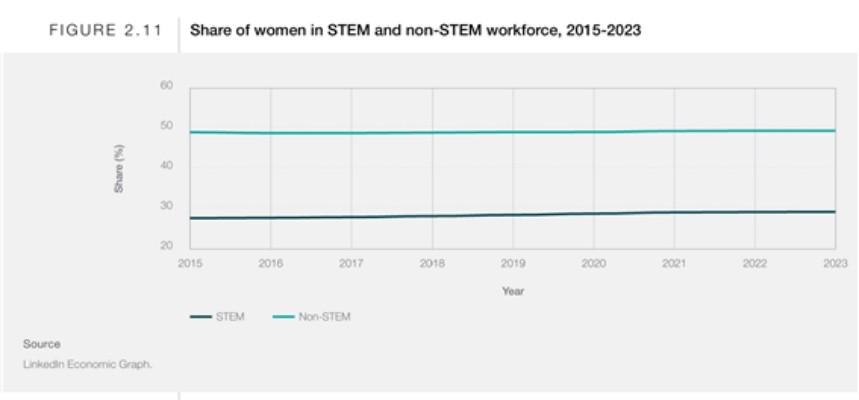
Women remain significantly underrepresented in STEM roles compared to non-STEM roles, and from 2015 to 2023, the gap has barely narrowed.
(출처: Source: World Economic Forum, Global Gender Gap Report 2023)
The upper line represents non-STEM fields.
The lower line represents STEM fields.
• In non-STEM fields, women account for approximately 48–50%.
• In STEM fields, women account for approximately 27–29%.
What stands out is not just the size of the gap but how little it has changed.
Over eight years, the gender structure of women’s participation in the overall labor market has remained largely stagnant.
This suggests that the issue is not merely a “glass ceiling” at the top.
It is closer to a reality where the game begins differently from the very entrance.
① The Entry Gap
– Who Gets to Enter First?
→ The UNESCO Science Report 2021 illustrates this gap at the very doorway
• Women make up approximately 33% of researchers worldwide.
• Women account for less than 35% of university students majoring in STEM fields.
• In disciplines such as engineering and computer science, the share drops to around 28%.
The starting line is already uneven.
As we move toward future-defining fields like AI and machine learning, that doorway becomes even narrower.
→ According to the World Economic Forum's (Global Gender Gap Report 2023
• Women represent about 22% of professionals in data and AI-related roles.
• Women hold only around 12% of executive positions in the AI industry.
The World Economic Forum (WEF) warns:
“Without intentional design, future technologies will replicate the gender gaps of the past.”
World Economic Forum (WEF)
 ̄ ̄ ̄ ̄ ̄ ̄ ̄
② The Retention Gap
– They Enter, But They Don’t Stay
The issue is not only about the entrance.
Even after entering, many women struggle to remain and eventually leave.
• Women in STEM are 2.4 times more likely than men to leave within 10 years.
• 67% of women in STEM report a high risk of career interruption.
The reasons are not new.
• Being the only woman in the meeting room.
• Childcare responsibilities still treated as a personal burden.
• Cumulative exclusion from promotions, research funding, and leadership roles.
These are not isolated acts of discrimination.
They are forms of fatigue that build up over time.
 ̄ ̄ ̄ ̄ ̄ ̄ ̄
③ The Leadership Gap
– Present Around the Lab Bench, Absent from the Boardroom
Once again, let’s turn to the numbers to understand the structure.
The graph below is based on LinkedIn labor market data analyzed by the World Economic Forum (WEF).
Simply put, it shows how the share of women changes as job levels rise — comparing STEM and non-STEM fields.
< Share of Women by Seniority Level in STEM vs. Non-STEM >
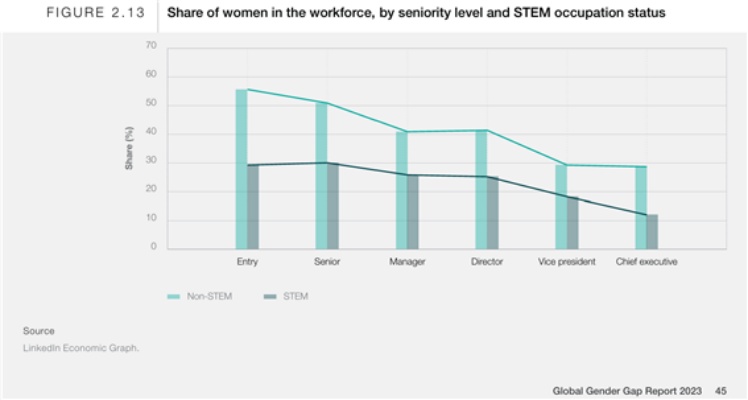
As seniority increases, the proportion of women declines and the drop is significantly steeper in STEM fields.
(Source: World Economic Forum, 『Global Gender Gap Report 2023』)
The black line represents women in senior positions within STEM.
The pattern is clear.
At the entry level, women make up about 28% of the STEM workforce.
But as time passes and roles advance, the picture shifts.
• From Manager → Director → Vice President, the share of women steadily decreases.
• By the time we reach the CEO level, women in STEM account for only around 11%, meaning 9 out of 10 are men.
In non-STEM sectors, by contrast, women still represent about 28% at the CEO level.
This difference tells us something important.
The issue is not individual capability.
It lies within the promotion structures and organizational culture of STEM institutions.
UN Women summarizes the situation this way:
“Women are more present behind the scenes in research settings, yet remain rare at the front of the stage where research directions and resources are decided.”
In other words, the voices determining what to research, which technologies to develop, and for whom they are designed remain disproportionately male.
 ̄ ̄ ̄ ̄ ̄ ̄ ̄
④ The Education Gap
– When Even Imagination Is Blocked
The gender gap begins as early as the education stage.
In many textbooks, the share of women scientists is less than 2%, and girls grow up hearing comments like:
“Isn’t engineering something boys are better at?”
“Wouldn’t you be more suited for the humanities?”
As these words and images accumulate, many girls begin to build a psychological barrier of their own,
“I don’t belong in that space.”
According to UNICEF’s analysis on STEM education, in many countries, girls perform at levels similar to or even higher than boys in math and science.
Yet they are far less likely to consider pursuing STEM careers.
▶ The percentage who say, “I can imagine myself working in STEM”:
• Girls: 43%
• Boys: 67%
The issue is not ability.
It is the range of futures young people are able to imagine for themselves.
If you would like to learn more about the global state of gender equality, read the next article below. ⇊ 132 Years to Full Gender Equality |
―
What Happens When Gender Equality in STEM Is Low
When Technology’s “Default Setting” Becomes Biased
―
Technology is never truly neutral.
Who designs it becomes the standard.
When medical data is built primarily around Western male bodies, women are more likely to receive later or less accurate diagnoses.
When automobile safety standards are based on the average male body, women face a higher risk of severe injury in car accidents.
This is not simply a matter of values or fairness.
It is a matter of safety and survival.
―
STEM Gender Equality and Peace
Why Does the United Nations Treat This as a Peace Issue?
―
The United Nations clearly links SDG 5 (Gender Equality) and SDG 9 (Industry, Innovation, and Infrastructure) within the Sustainable Development Goals (SDGs).
The more women participate in designing technology, the more balanced and inclusive the solutions become especially for global challenges such as climate change, public health, and digital democracy.
The World Bank and UNDP also point out:
“Countries with higher levels of women’s education and economic participation tend to experience reduced income inequality, as well as lower levels of social and political conflict and violence.”
―
What We Can Do
Asking Questions Now, Instead of Waiting for Perfect Answers
―
《Keep asking: “Who is the default here?”》
Sometimes, it’s enough to slowly scan the space you belong to.
↓↓↓
• In our department, lab, or company, what is the representation of women and minorities?
• Who sits at the table when key decisions are made?
• In textbooks, course materials, and seminars, whose names are repeatedly cited and which direction do they lean?
This is not about being overly sensitive.
It is closer to quietly checking the default settings of our environment.
↓↓↓
• “Who might this algorithm disadvantage?”
• “How might this technology affect different genders or social groups?”
You don’t have to provide immediate answers.
Sometimes, the question alone can begin to shift the direction of the conversation.
《Connecting with Global Programs》
Across the world, efforts to advance gender equality in STEM are already underway.
• UNESCO – Girls in STEM / Girls in ICT initiatives
• Microsoft Women in STEM Scholarship (regionally operated)
• National networks of women scientists, coding education programs, and community-based initiatives
Even if you do not participate directly, simply sharing information and connecting others can be meaningful.
Change is not created alone.
It grows by adding more people to an existing movement.
《If You’re a Developer or Researcher, Leave Fairness in Your Code》
If you write code, you can go one step beyond simply being aware of bias.
◾ IBM’s AI Fairness 360 Toolkit
◾ Various open-source fairness libraries
Take the time to examine whether the model you built disadvantages certain groups.
That process is less about making declarations and more about translating the language of equality into the language of practice.
《One Question That Matters More Than Action》
Rosalind Franklin made a decisive contribution to uncovering the structure of DNA, yet for many years her name went largely unrecognized.
Her words quietly bring together everything we have discussed:
“Science is neither of man nor of woman. It is of humanity.”
— Rosalind Franklin
In the end, the question that remains is neither grand nor dramatic.
In the classroom where you sit,
in the lab where you work,
in the company you belong to
This technology and this knowledge, whom do they naturally invite in, and whom do they leave outside?
The moment you begin to ask that question, you have already taken a step toward gender equality in STEM.
Change does not always begin with raised voices.
More often, it begins quietly with someone who starts questioning the default.

#GenderGap
#WomenInSTEM
#STEMEquity
#GenderEquality
#DataTellsTheStory
Written by Sharon Choi
Director of Planning
Sunhak Peace Prize Secretariat
Further Reading : |